News

Working with families carers and kin
Advocacy

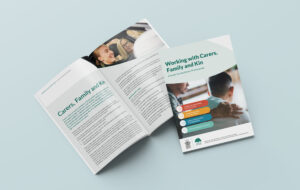
Working with Carers, Family and Kin – A Guide for Healthcare Professionals

We are excited to share a new resource Arafmi has developed, through our membership of the Queensland Carer’s Advisory Council. This new resource is designed for healthcare professionals, to ensure they are aware of the rights of carers, the challenges they face, and how working with carers can help them deliver the best care possible for their patient. It’s called Working with Carers, Family and Kin – A Guide for Healthcare Professionals, and can be found here. We’re working hard now to get this in front of decision-makers and clinical staff. We hope you like it, and if you have any feedback or ideas please email marketing@arafmi.com.au Read the guide here

Read More »
Website blog post headers
Mental Health

Volunteer Profile: Julie

Arafmi Volunteer Profile: Julie As part of National Volunteer Week (19–25 May), Arafmi Communications Officer Lilly Provenzano sat down with one of our volunteers, Julie, to reflect on her experience as a carer support group facilitator. Can you tell us a little about yourself as a Volunteer for Arafmi? I’m a 54-year-old Mum to 3 beautiful, strong women in their 20s. I’ve been a single Mum for 20 years and have only just been able to buy my own unit. I might have to work for another 30 years to pay it off, but it will all be worth it!!! What inspired you to volunteer with Arafmi as a support group facilitator? I had been coming to the New Farm meeting for approx. 7 years. The meetings had been run by Ailsa Whitehead for a very long time but unfortunately she lost her eyesight (in her early 90s) after having a stroke and was no longer able to facilitate. She had mentioned prior to the stroke that she could ‘fall off the perch’ at any time and wanted to know that her beloved New Farm group would continue without her at the helm. I fell into this role never thinking

Read More »
Helen BlogpostHeader
Mental Health

Volunteer Profile: Helen

Arafmi Volunteer Profile: Helen As part of National Volunteer Week (19–25 May), Arafmi Communications Officer Lilly Provenzano sat down with one of our volunteers, Helen, to reflect on her experience as a carer support group facilitator. 1. What motivated you to become a support group facilitator at Arafmi?I had been attending support groups for five to six years, participating as a carer myself. I was inspired. I have much admiration for them and observed the facilitators and staff clearly during this time. They were so clever and kind navigating big groups and people in trauma. The opportunity arose so I put my hand up. 2. Can you describe what typical support group sessions look like?Typically, they are varied in age, gender and circumstance. At my group, we see parents, serving long-term partners, sometimes both parents – different dynamics. Every support group session has an informal welcome, a check-in for newbies and then the more practical things like name badges. We welcome people, there are beverages. We do an Acknowledgement to Country.We spend time explaining the guidelines that the two-hour conversations operate under. We may talk about the time that every person gets to share – that there is no interrupting.

Read More »
Margaret BlogpostHeader
Mental Health

Volunteer Profile: Margaret

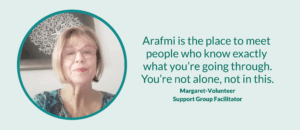
Arafmi Volunteer Profile: Margaret As part of National Volunteer Week (19–25 May), Arafmi Communications Officer Lilly Provenzano sat down with one of our volunteers, Margaret, to reflect on her experience as a group facilitator of one of our Brisbane carer support groups. 1. What motivated you to become a support group facilitator at Arafmi?I have been to support groups for years, maybe 16–17 years in the same group. It’s moved from place to place over the years. I was offered to facilitate a group as a natural progression with staff and participants.It’s an amazing group of people. The organisation itself is a treasure. I wanted to join Arafmi as it drew me in and plays a valuable role in society. It’s the values of the Arafmi team that really encouraged me to remain. You can get a job anywhere but to live and breathe values is unique. I am grateful for the people, grateful for the leadership and have a lot of faith in the wonderful CEO who leads from the front. 2. Can you describe what a typical support group session looks like?There can be a new member or the same group of people at Inner Brisbane. It’s a

Read More »
Website blog post headers
Advocacy

Federal Election: Mental health commitments by major parties

Mental health carers are still missing from major election promises. Clinical services help—but carers carry the load between the gaps. This election, ask your candidates: Where is the support for carers? Mental Health Carers Australia has responded to the major parties’ funding commitments, highlighting what’s included, what’s missing, and why carer voices must be part of the plan. If you support someone with mental ill-health, it’s worth a read. Read the full MHCA response here: https://arafmi.com.au/wp-content/uploads/2025/04/MHCA-Response-to-Major-Party-Election-Commitments.pdf

Read More »
ProdCommission
Advocacy

Speaking Up for Mental Health Carers

Did you know? An estimated 1 million Australians were caring for someone with mental ill-health in 2018, with 700,000 living in the same household. Replacing that unpaid support was valued at $13.2 billion (in 2016)—nearly twice what was being spent on all mental health services at the time. That’s why Arafmi’s Sue Goodwin, Lived Experience Advocacy Team Lead, and Alex Tyson, General Manager Carer Programs and Advocacy met with the Productivity Commission to make sure mental health carers are prioritised in the National Mental Health and Suicide Prevention Agreement. They raised that services and supports for families and unpaid carers need to be part of the mental health system—and valued just as much as services for people experiencing mental ill-health. Without this, carers face long-term emotional, physical, mental and financial impacts. The discussion also highlighted the need for support beyond just primary carers—like children and young people caring for a parent or sibling, and family groups, kin, and chosen family. Everyone involved in the caring journey deserves to be seen and supported. Other key issues included the 92,000+ Queenslanders with moderate and severe psychosocial needs still missing out on care, the lack of after-hours crisis services, and the additional pressures faced by

Read More »
PoweringUpSummitReflection
Advocacy

Reflections on the Powering Up Lived Experience Workforce Summit: Written by Heidi Höynk

Attending the Powering Up Lived Experience Workforce Summit in February 2025 was an eye-opening experience. As a long-time carer navigating Queensland’s mental health system, I’ve often found myself feeling frustrated, unheard, and exhausted—not because support doesn’t exist, but because the system itself can be isolating and unresponsive. Organisations like Arafmi have been invaluable in providing a space for carers to feel supported and heard, helping to pick up the pieces when the system fails us. However, the treatment of carers, of loved ones and the systemic issues within mental health services remain draining and disheartening. Stepping into this summit, surrounded by others who truly understood these challenges, I felt a renewed sense of purpose and possibility. Over two days, I had the opportunity to listen, learn, and reflect on what lived experience means in the context of systemic change. Dr. Louise Byrne set the tone with a simple yet profound truth: the lived experience workforce is real, it’s on the ground, and it’s making a difference. Authenticity is key—our stories, both the good and the ugly, are not just valuable but necessary in shaping better services. However, it’s not just about being present; it’s about ensuring we have an equal

Read More »
QB Submission
Advocacy

Submission to the Queensland Budget 2025 – 2026

Submission to the Queensland Budget 2025-2026 In this joint pre-budget submission to the Queensland government’s 2025 budget, QAMH, Arafmi, and MHLEPQ call on the Government to deliver long term solutions by: 1. Jointly funding the identified gap in Queensland’s psychosocial supports. 2. Expanding the support available to families and other members of regional, rural and remote communities who provide unpaid care for those experiencing mental health challenges. 3. Commencing preparatory work for the next iteration of the Better Care Together plan. 4. Strengthening the embedding of Lived Experience across Queensland Government systems and services. 5. Funding a well-resourced ecosystem of supports, based on social prescribing, to reduce the burden on clinical services.  Read the full submission below. Read here

Read More »
emergency graphic
Advocacy

Preparing for Tropical Cyclone Alfred

Tropical Cyclone Alfred is expected to bring heavy rainfall, damaging winds and potential flooding to Brisbane and surrounding areas in the coming days. As carers, it’s essential to take extra steps to ensure both your safety and the wellbeing of those you support. Below are  preparations to help you stay safe before, during and after the cyclone. Helpful Resources Get Ready QueenslandGet Ready Queensland is a year-round program helping all Queenslanders prepare for natural disasters. Being prepared before a disaster hits could be the difference between staying safe or putting yourself in danger. Create an emergency plan at Get Ready QLD. The easy to follow guide will help you know your risks, make a safety plan and make an emergency kit. Bureau of MeteorologyVisit the Bureau of Meteorology for regular forecasts, warnings, monitoring and advice. Local CouncilYou can sign up to Brisbane City Council’s Severe Weather Alerts here, or visit the following emergency pages: Redlands City Council, Moreton Bay, Ipswich, Logan, Gold Coast and Sunshine Coast. ABC RadioYou can pre-program your local ABC radio station into your preferred digital music service and on your battery operated radio, so that you can tune into warnings if the internet goes down. ABC EmergencyThe

Read More »
Arafmi 324
Advocacy

Arafmi Mental Health Carer Forum 2024

Arafmi Mental Health Carer Forum 2024  Our Mental Health Carer Forum on 16 October provided an important opportunity for mental health carers to hear from leaders in the mental health system, connect with other carers and learn how to utilise their Lived-Living Experience to advocate for better support for themselves and the people they care for. Outcomes of the Carer Forum Round Table Discussions The insights from the Carer Forum round table discussions will guide the Advocacy Team’s priorities and future focus areas. The top priorities identified by carers on the day were centred around enhancing mental health awareness and carer support by: education of GPs and other health professionals about carers and support for carers promotion of existing supports to carers, including making distinctions between crisis supports and ongoing supports for young carers (aged 4 – 25), training for schools and teachers on how to recognise, refer and support young carers, as well as education of young people on signs of mental health challenges. Other top issues included: raising awareness of trauma from past mental health and child safety systems, proactive outreach to carers when someone engages with the mental health system, providing clear information to carers and involving

Read More »
Skip to content