ProdCommission

Did you know? An estimated 1 million Australians were caring for someone with mental ill-health in 2018, with 700,000 living in the same household. Replacing that unpaid support was valued at $13.2 billion (in 2016)—nearly twice what was being spent on all mental health services at the time.

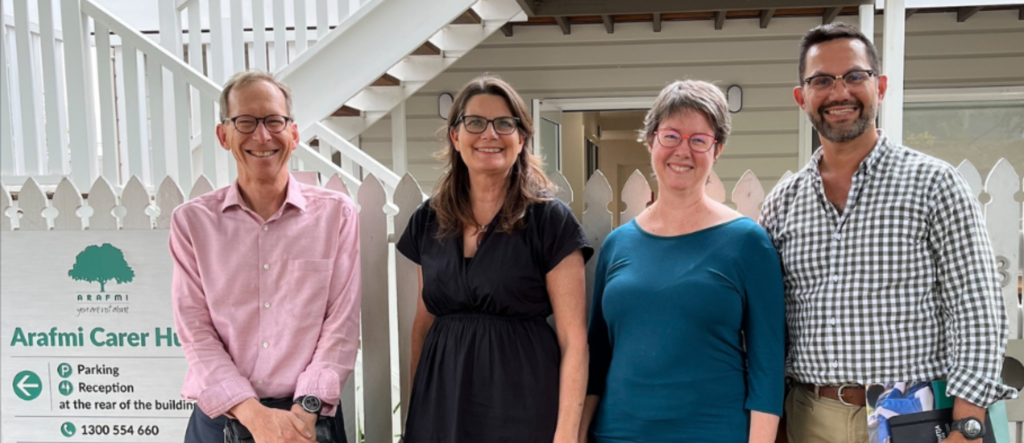
That’s why Arafmi’s Sue Goodwin, Lived Experience Advocacy Team Lead, and Alex Tyson, General Manager Carer Programs and Advocacy met with the Productivity Commission to make sure mental health carers are prioritised in the National Mental Health and Suicide Prevention Agreement. They raised that services and supports for families and unpaid carers need to be part of the mental health system—and valued just as much as services for people experiencing mental ill-health. Without this, carers face long-term emotional, physical, mental and financial impacts.

The discussion also highlighted the need for support beyond just primary carers—like children and young people caring for a parent or sibling, and family groups, kin, and chosen family. Everyone involved in the caring journey deserves to be seen and supported.

Other key issues included the 92,000+ Queenslanders with moderate and severe psychosocial needs still missing out on care, the lack of after-hours crisis services, and the additional pressures faced by carers in rural and remote areas. In Queensland, mental health and suicide prevention services are still not well integrated between state and federal levels—leaving carers to fill the gaps.

They also flagged the lack of national data. Aside from Arafmi’s statewide consultation and a few surveys, there’s very little information about mental health carers—who they are, what they experience, or what support they receive. And without data, carers stay invisible.

The Commissioners were genuinely interested and open to ideas. They were particularly impressed by the Carer Hub model and shared thoughts on how GPs and the peer workforce could play a bigger role in supporting mental health carers.

Find out more about the review at pc.gov.au/inquiries/current/mental-health-review
Related Posts:

Hidden Role of young carers
Carer Event

The hidden role of young carers

“I just thought it was normal” – the hidden reality of young mental health carers For many young people, caring doesn’t have a name. It’s something they do as part of everyday life, being there when someone needs them. As Tanya Boge from our Carer Support Team explains: “Many young mental health carers don’t identify with the word ‘carer’ they see what they do as just helping out.” What often goes unseen is everything that sits behind that. The mental load, the worrying, the responsibility, and the feeling like they have to stay strong, even when things are uncertain. Over time, that can begin to shape how young people see themselves and where their own needs fit. “Many also grow up without clear boundaries, which can make it harder to balance their own needs alongside supporting someone else.” For Tanya, this understanding comes from her own experience. “It’s important to me because I was a young mental health carer myself, even though I didn’t have that language at the time. I just thought it was normal to take on that level of responsibility and not have clear boundaries.” Looking back, she can see how those early experiences shaped her. “Without

Read More »
Meet Carol
Arafmi Staff

Meet the Carer Gateway Team: Carol from Townsville

Support where it didn’t exist before Meet Carol, supporting mental health carers in Townsville When Carol Sheeren sits down with a carer for the first time, she notices the same moment. “You can actually see it… they relax and just exhale.” She calls it “the great exhale”, that instant when someone realises they finally have space just for them, and someone who will listen without judgement. Carol is Arafmi’s Carer Gateway Carer Facilitator in Townsville. Since starting last August, she’s been quietly building connections, supporting carers one-on-one, linking them with resources, and offering support where it hasn’t always been available. Her work is part of Arafmi’s partnership with Wellways Carer Gateway, bringing support into regional and remote communities. Meeting carers where they are Without a dedicated hub in Townsville, Carol meets carers where they feel most comfortable, a park, a café, or a quiet space away from home. She also spends one day a week at the Medicare Mental Health Centre, where she meets carers and connects them with other supports. That choice gives carers a chance to step out of their role, even briefly, and focus on themselves. “People often need that first… just to feel supported before they’re

Read More »

Speaking Up for Mental Health Carers

Skip to content