Arafmi Volunteer Profile: Margaret
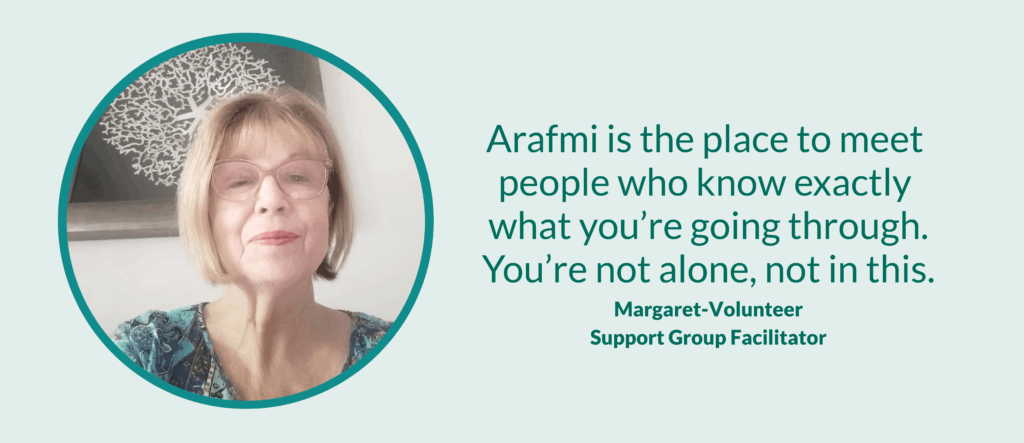
As part of National Volunteer Week (19–25 May), Arafmi Communications Officer Lilly Provenzano sat down with one of our volunteers, Margaret, to reflect on her experience as a group facilitator of one of our Brisbane carer support groups.
1. What motivated you to become a support group facilitator at Arafmi?
I have been to support groups for years, maybe 16–17 years in the same group. It’s moved from place to place over the years. I was offered to facilitate a group as a natural progression with staff and participants.
It’s an amazing group of people.
The organisation itself is a treasure. I wanted to join Arafmi as it drew me in and plays a valuable role in society. It’s the values of the Arafmi team that really encouraged me to remain. You can get a job anywhere but to live and breathe values is unique. I am grateful for the people, grateful for the leadership and have a lot of faith in the wonderful CEO who leads from the front.
2. Can you describe what a typical support group session looks like?
There can be a new member or the same group of people at Inner Brisbane. It’s a small cohesive group. We’ve known each other for years. We know each other’s stories and backgrounds and we share friendship. Seeing an old friend or meeting new people, we always give attention to those –the people in our group have been there for quite some time.
We are conscious of the new people and give them space to share new stories and try to be helpful. Our problems don’t go away but we are there to be hopeful and invite them back to this special space. I would say that we have macabre things and a ‘dark’ sense of humour that gets us through.
3. How do you create a safe and welcoming space for mental health carers?
We try not to interrupt. New members come in and we give lots of eye contact and acknowledge their story. There are time constraints when we have big groups of people and we have to wrap it up but we really do allow our newer people to have a bit of space to speak. Our group encourages jumping into conversation with Lived Experiences but we are mindful – let them know that it’s okay to express themselves, okay to feel, okay to cry. We always tell them that we hope that they come back and (they reply) they’re glad that they found us.
4. What are some common themes carers share during the group sessions?
The common theme would be that they are glad that they found Arafmi – they did not know this existed. Often, people express being distraught and uncertain and talk about problems with people in their lives – often adult children. From our experience and our group, they are desperate to know what to do. We all sit and let people talk and let them know whatever is said is okay and that we understand. They are encouraged to share but also encouraged to sit and observe and that there’s no expectation of sharing at all.
Recently, a situation came up where a carer was going to pay off a big debt for the person that they care for, which was just adding up to being a lot of money. But the carers in the group were actually able to offer a solution from the Lived Experience they had and information shared so that this debt didn’t become the carer’s debt. It is a very helpful and safe place.
5. How do you look after your own wellbeing while holding space for others?
Personally, I am very good at compartmentalising the distress that I have in the mental health space. Once I put on that facilitator hat, it’s a really great diversion for me. I’m retired now and previously, work was also a great diversion and distraction. If ever this was impossible to do, I would hand over my responsibilities to the co-facilitator for this session. I do feel that when we share these experiences and stories, that it builds trust and authenticity amongst the group. I have been involved in the stories in the support group for 17–18 years.
6. What do you think makes peer support so powerful for carers?
I think the fact that they aren’t alone and that there’s support in numbers is extremely powerful. To come to Arafmi and meet other people with these experiences – there’s nowhere else to go that has that kind of support in the medical systems. It’s the best ‘port of call’ you can make on the carer journey. There are walls that you are up against in the medical field. It does feel like there’s no hope with caring for people with severe mental illnesses as there are no cures. It’s an endless ‘tragedy cycle’ and you have to learn that you are on a journey, that it’s a little cyclical in nature. There is a grief and a loss for everyone concerned. Arafmi is the organisation you can go to to find people who experience exactly the same as you.
7. What have you learnt from carers who attend your group?
They’ll arrive in the deepest of tragedies or they’ll arrive happy within themselves. It’s really easy, when you get that perspective, to see that it is a cycle and seasonal and it really just depends what’s going on with their family member. There is a common quote that is said in the caring dynamic, “If you’re okay, I’m okay.” We become immersed in the world of that tragedy. The things that Arafmi does, it not only provides information and respite and events for carers, it gives hope and uplifts carers. We all need to know that outside of the world that brought us to Arafmi, there is another world that has joy, laughter, friendship. We need to fight tooth and nail to find that world, lightening the burden of the one we carry. Soon, we let go of the “I want a cure for mental illness” and we lean more into “I need to have a life outside of this world.”
8. Can you share one moment that really stayed with you?
A couple of years ago, I attended a weekend away, an Arafmi retreat. There was a swim-up bar, hanging out by the pool and there were hundreds of people –hundreds of women and only a handful of men. All the women shared that they hadn’t been away from their caring role for many years — some two, some three, some five years since having a break from their caring responsibilities. This saddened me but it really made me appreciate the service Arafmi gives by offering these retreats.
9. How do you support new attendees who may be feeling nervous or unsure?
There really is nothing different that we do in this circumstance. In my experience, people don’t come in unsure or nervous. Highly emotional people enter. We give focus, suggest that they sit and listen for a while and hop in when they’re ready, then invite them in to speak if they don’t speak up themselves. We do encourage people. We do reassure people that they don’t need to share their stories if it’s uncomfortable and that that’s okay too.
10. What would you say to someone who’s thinking about volunteering for support groups?
Just do it. It’s a great time if you want to volunteer and join a company that lives its values – this one is for you.