Arafmi Volunteer Profile: Julie
As part of National Volunteer Week (19–25 May), Arafmi Communications Officer Lilly Provenzano sat down with one of our volunteers, Julie, to reflect on her experience as a carer support group facilitator.
- Can you tell us a little about yourself as a Volunteer for Arafmi?
I’m a 54-year-old Mum to 3 beautiful, strong women in their 20s. I’ve been a single Mum for 20 years and have only just been able to buy my own unit. I might have to work for another 30 years to pay it off, but it will all be worth it!!!
- What inspired you to volunteer with Arafmi as a support group facilitator?
I had been coming to the New Farm meeting for approx. 7 years. The meetings had been run by Ailsa Whitehead for a very long time but unfortunately she lost her eyesight (in her early 90s) after having a stroke and was no longer able to facilitate. She had mentioned prior to the stroke that she could ‘fall off the perch’ at any time and wanted to know that her beloved New Farm group would continue without her at the helm. I fell into this role never thinking I’d have the confidence to facilitate a meeting.
- How long have you been part of the Arafmi team?
I became a co-facilitator of the New Farm meeting in 2023.
- Can you describe what a typical support group session looks like?
At the New Farm meetings, we have 2 co-facilitators and take it in turns each month to facilitate the meeting. Whoever’s not facilitating watches the door for latecomers. We are given a heads up if there will be new carers joining us, but we never know how many people will show up. I’ve seen as little as 3 carers in a meeting up to 17 carers!
- How do you create a safe and welcoming space for mental health carers?
Ailsa always believed you set up the space with the chairs in a circle and remove any tables so there’s no barriers between anyone. We continue to set up our room this way. Carers enter into the kitchen area first where they are welcomed, given a name tag and offered a cuppa and something to snack on. We then go into the meeting room and always aim to start on-time. There’s always boxes of tissues within reach!
- What are some common themes carers share during group sessions?
The fact that they don’t feel comfortable opening up to their family or friends about what’s going on in their lives. Some people just don’t understand! The first group session is overwhelming and emotional but it’s a space that you can come and go, and it doesn’t matter how much time passes in between – you can pick up where you left off.
- How do you support new attendees who may be feeling nervous or unsure
There is never any pressure for new people to open up about what’s going on in their lives. They are encouraged to share only when they feel comfortable to do so.
- Can you share a moment that really stayed with you from group (no personal details).
A carer came to their first meeting, and it was apparent they’d lost all hope. By the time they left there was lots of smiles and when they came back the next month they shared that they felt a huge weight had been lifted and they didn’t feel alone in their journey anymore. It was really heartwarming, and I’ve loved seeing how far they’ve come in a short amount of time.
- How do you look after your own wellbeing while holding space for others?
I allow myself to have a bad or sad day when needed but also have the attitude that ‘tomorrow is a new day with new beginnings’. I know I can also reach out to others who I have met through Arafmi that I can vent to.
- What have you learned from carers who attend your group?
Carers are the most resilient humans who have gone through the unimaginable, but they continue to get up each day, put their own needs behind them while providing love and support to the people they care for.
- What would you say to someone thinking about volunteering with Arafmi?
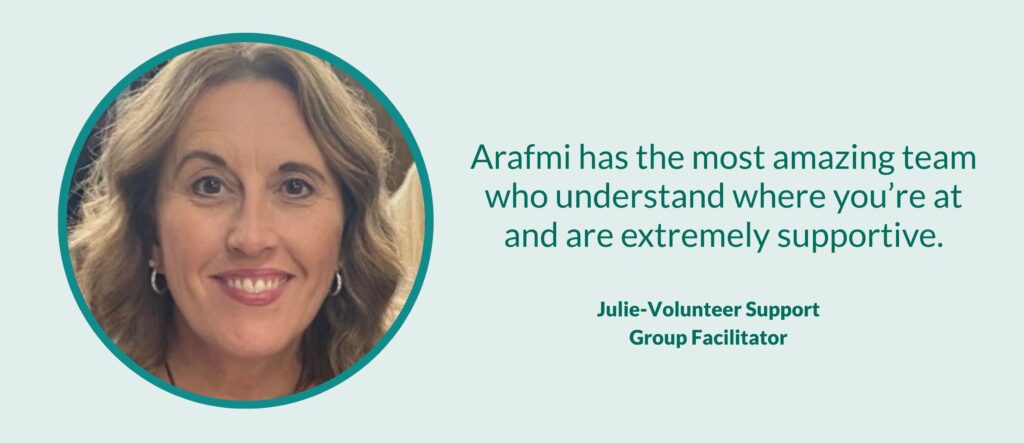
Chances are you have a huge amount of lived experience, therefore, you’re the perfect person to volunteer! Arafmi has the most amazing team who understand where you’re at and are extremely supportive. They really look after their volunteers, and they value their contributions.
- Why do you choose to volunteer your time and energy to support mental health carers?
I love to give back to people and organisations who have been there for me. My journey as a carer has bought some really dark times in my life and some really amazing times with the ones I have cared for. By sharing my story, I feel I can provide hope to others who are going through their darkest times. If one person walks away feeling better than they did when they arrived, my time has been well worth it.
- What is one piece of advice you would give to a carer who feels isolated right now?
Sorry but I can’t just provide one piece of advice! Just pick up the phone and call Arafmi on 1300 554 660. If you can get to a support group meeting you will never look back! If you can’t, do as many workshops and information sessions you can that Arafmi have on offer. You’ll feel so much better when you arm yourself with useful information.
- How would you describe the feeling in the room during a support group in just three words?
Supportive, comforting, knowledgeable.
- What personal strengths have you discovered or strengthened through volunteering?
With each support group meeting I facilitate, my confidence grows. I also have learned that I don’t need to provide all the answers, I just need to listen without judgement.
- What does being part of the Arafmi community mean to you?
I’m really proud to talk about Arafmi to anyone who I feel needs to hear about the services they offer. Chances are we all know of someone who is a carer for a loved one with mental ill-health. Arafmi are always interested to hear from carers with lived experience and I know they will always take your feedback on board. My most favourite thing about Arafmi is how the staff make carer’s feel so special with the events and retreats they organise.
- Can you share a small, funny, or heartwarming moment from a group session?
I hope this doesn’t come across the wrong way, but a carer once shared an awful thought they’d been having but we all ended up in fits of laughter because we’d all had the same thought at some time. Being a carer you sometimes have to just laugh some things off even though others would think the situation was horrific! As my darling Grandad would always say, you’ve got to have a sense of humour!’
- What gives you hope for the future of carers and mental health support?
There’s so much more awareness around mental health issues now. It is my hope that doctors, psychologists, psychiatrists etc will relax the privacy clause and liaise with family/those caring for people with mental health issues, to get a true insight into what’s really going on. As carers, we know the truth isn’t always told to the medical treatment team. I believe the treatment may be more beneficial if they did work with those closest to the person with mental health issues.