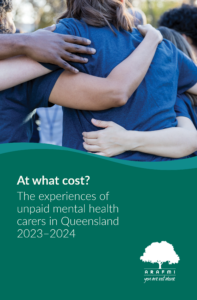
At what cost?

Arafmi’s inaugural mental health carers report: ‘At what cost? The experiences of unpaid mental health carers in Queensland 2023 – 2024’

“At What Cost?” collates and analyses the feedback from carers in consultations held by our Advocacy Team, late last year. The report has been mailed out to all State MPs, Queensland-based Federal MPs, senior public servants and other stakeholders. Follow-up meetings will occur to raise awareness of the systemic reforms that carers need.

In this report, Arafmi has identified six areas for action that will guide our advocacy work over the next two years:

  1. Raise awareness of mental health carers so that they can be better recognised and supported.
  2. Advocate for physical, emotional, social, mental health, and practical support for mental health carers.
  3. Facilitate access to relevant information and training for mental health carers.
  4. Promote carer inclusion in mental health treatment planning and implementation.
  5. Increase financial assistance for carers.
  6. Advocate for inclusion of the voices of mental health carers in mental health reform.

A summary of the key findings and recommendations can be found in the document below:
"You often find out the hard way what’s available and what would’ve helped in the early stages. It would be good to have someone support you from the beginning and throughout the journey to help connect to services.”

"When you lose yourself in life due to caring, that's wwhen you become a carer. You aren't just a mum or dad.”

Related Posts:

Meet Sue
Arafmi Staff

Meet the Carer Gateway Team: Sue from the Sunshine Coast

“I’m actually on your team.” Meet Sue, supporting mental health carers on the Sunshine Coast.  “The person that you care for has a whole team of people around them, but I’m actually on your team.” It’s a sentence Sue comes back to often because she’s seen what happens when a carer hears it for the first time. Every day at the Sunshine Coast Carer Gateway Hub, people caring for a family member, partner or friend living with mental health challenges walk through the door looking for support. For Sue, it often starts with something simple: a smile, a cup of tea and a place to sit. Ask Sue what she loves most about her work, and her answer isn’t what you’d expect. It’s seeing the moment someone realises they don’t have to carry it all on their own. “It probably comes right back down to the look on somebody’s face when they realise that they’ve got somebody on their side and that they can be whoever they want to be. And we’re not going to judge them, we’re just going to try and support them the best way we can.” Putting carers back at the centre Most people walk through

Read More »
Image 29 4 2026 at 3.25 pm
Carer Story

From carer to lifeline: The Queensland volunteers helping others mental health carers

From carer to lifeline: The Queensland volunteers helping other mental health carers For Arafmi volunteer Louise Dutton, when her son became unwell with mental ill-health, she “didn’t really know what she was dealing with.” That’s where her connection with Arafmi began, not as a volunteer, but as a carer trying to make sense of something overwhelming, unfamiliar and at times isolating. Over time, that experience became something she could offer others. Now 82, she’s spent the past 25 years answering calls on the 24-hour Carer Support Line and sitting alongside carers in support groups. What she brings isn’t a set of answers, but a way of helping people feel understood. As she explains, “Listening plays a big part. And so you’ve got to find out where the person is coming from… sometimes the person is so stressed that they can go round and round in circles. You just try and pick out a few points and confirm, is that what you’re telling me? And then try and help them to understand that we know where they’re coming from because we’ve had a similar experience.” For carers reaching out, that recognition can be enough to help people feel more steady and

Read More »

Arafmi’s inaugural mental health carers report: ‘At what cost? The experiences of unpaid mental health carers in Queensland 2023 – 2024’

Skip to content